
K53 test pass mark: the three sections and how many you can get wrong
By The PassPath Team · Published · Updated
The K53 learners test does not have one pass mark. It has three, one for each section, and you have to clear all three. Here is the table, then what is in each section and where the marks go.
| Section | Questions | You need | Can get wrong |
|---|---|---|---|
| Rules of the road | 28 | 22 | 6 |
| Road traffic signs | 28 | 23 | 5 |
| The controls of the vehicle | 8 | 6 | 2 |
| Total | 64 | All three must clear | |
Government Notice R.93 of 2006, Government Gazette 28446, section 5.4. The three thresholds are joined by the word “and” on the face of the notice, and no overall percentage appears anywhere in it.
What the three pass marks mean in practice
There is no total, no average and no overall percentage. Nothing you did well in one section can carry a weak one. That produces an arithmetic result most people find hard to believe until they check it on their fingers.
Get every single rules question right. Get every single signs question right. That is 56 out of 56. Then drop three of the eight controls questions.
28/28 + 28/28 + 5/8 = 61 out of 64. Ninety-five percent. Fail.
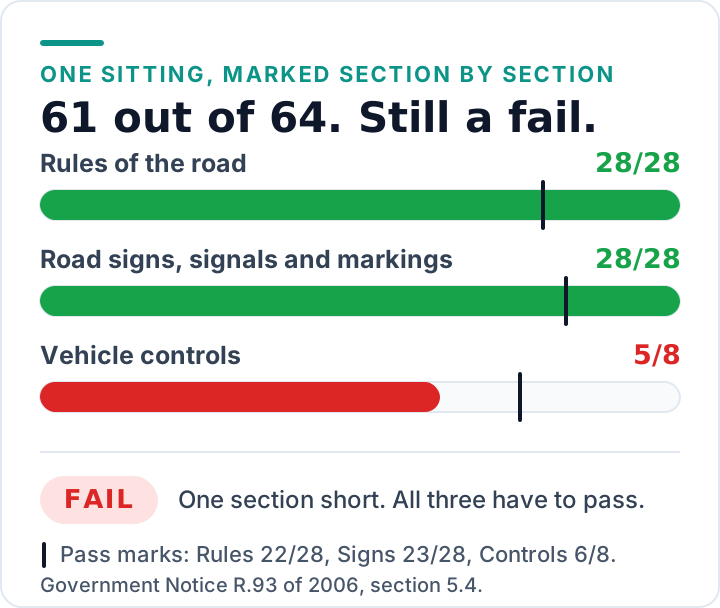
Notice where it bit. The smallest section is the one with the least room to be wrong: two wrong answers out of eight is a quarter of your total risk sitting in an eighth of the test. That is arithmetic, not a claim about candidates. Which section people fail most often is not published by anyone, and we do not guess at it.
Section 1: the rules of the road (28 questions, need 22)
This is the section people most often misjudge, because the name sounds like it means right of way and following distance. Some of it is. Most of it is not.
The Department of Transport’s own manual for this section is free, and it spends most of its length on the legal and mechanical requirements of the vehicle and the driver:
- Lights and lamps. Main beam, dipped beam, parking lamps, rear lamps, stop lamps, number plate lamps, fog lamps, spot lamps, and when each may be used.
- The vehicle itself. Steering, brakes, hooter, windscreen and wipers, exhaust silencers, tyres, number plates, rear-view mirrors, emergency warning triangles, seatbelts and child restraints.
- Limits and dimensions. Speed limits, vehicle length, height and width, projections and overhang, carrying goods, and when people may be carried on a goods vehicle.
- Driving itself. Keeping left, lane changing, driving signals, indicators, overtaking, intersections, parking and stopping, freeways, towing, compulsory stops, and the general duties of a driver.
- Offences and obligations. Cell phones, pedestrians’ right of way, what you must do after an accident, inconsiderate driving, reckless or negligent driving, and driving under the influence.
If you have been revising junctions and yielding and nothing else, this is the section that will catch you. A question about the maximum height of a load, or which lamp you may use in fog, is a rules-of-the-road question, and it is worth exactly as much as one about a four-way stop.
Section 2: road traffic signs (28 questions, need 23)
The highest threshold on the test. Five wrong answers and this section is gone, and “signs” is a much wider word than it looks. The Department’s signs manual covers four families of sign plus three things that are not signs at all.
The signs
- Regulatory signs. Control signs (stop, yield), command signs, prohibition signs, reservation signs, comprehensive signs, selective restriction signs, de-restriction signs, and combination signs that stack two messages on one board.
- Warning signs. Road layout, direction of movement, symbolic warnings, and combinations.
- Guidance signs. Route markers, freeway direction signs, diagrammatic and overhead diagrammatic signs.
- Information signs.
And the three things people forget are in here
- Road markings: regulatory, warning and guidance markings. The paint on the road is examinable.
- Traffic signals: the full behaviour of a robot, including flashing red arrows, constant amber arrows, flashing green arrows, flashing amber discs, pedestrian figure signals, and overhead lane control (the green arrow and the red cross above a lane).
- Hand and flag signals: a traffic officer’s control hand signals, which the manual notes take precedence over any other traffic signal, and the stop, proceed and warning flag signals used at roadworks or where animals are being led across a road.
Two signs that look almost identical, or a signal you have only ever seen from the passenger seat, are where the five wrong answers go quickly.
Section 3: the controls of the vehicle (8 questions, need 6)
The shortest section and the shortest manual. For a light motor vehicle with a manual gearbox, the Department’s manual gives a numbered diagram with eleven controls: the centre rear-view mirror, the window wiper, the left and right rear-view mirrors, the steering wheel, the indicator light switch, the gear lever, the hand brake, the clutch, the brake, the accelerator and the horn.
Questions here are typically about which numbered control you would use for a given job. The manual’s own sample questions include answers that name more than one control at a time (“6 and 8”, “1 and 3”), and at least one question of the form select the correct combination. If you have only ever practiced questions with one right answer out of four, that is worth knowing in advance. How many questions are in the K53 test sets out what is and is not published about the formats.
Eight questions, two wrong answers allowed. This is the section to over prepare, and it is the cheapest one to over prepare, because there are only eleven things to know.
Does the controls section change if I am not driving a car?
The content does. The number of questions does not.
The regulation requires the examiner to satisfy themselves that you know the controls of a motor vehicle of the class to which the application relates, and only the controls limb carries those words. So a motorcycle candidate is examined on motorcycle controls. The Department’s manual numbers nine controls for a motorcycle and eleven for a light motor vehicle, and the two lists do not line up: control 5 is the throttle on a motorcycle and the indicator switch on a car.
The count is the same for everybody. Government Notice R.93 of 2006 says 6 out of 8 for the controls of the vehicle, in one table, with no mention of licence codes anywhere.
PassPath K53 covers Code 2, the car, only. If you are booking a motorbike test, the eight controls questions you will face are not the eight we teach, and you should know that before you spend anything.
How this should change what you study
Three practical consequences fall out of the numbers.
- Do not average yourself. “I am getting about 80% overall” is not a measurement of anything the test does. The test asks three separate questions about you and takes the worst answer.
- Give controls more time than its size suggests. It is an eighth of the test and it carries a quarter of the risk. Eleven numbered controls is a single evening’s work.
- Treat signs as the widest section, not the easiest. Markings, robots, hand signals and flag signals all live there, and it has the tightest threshold on the test.
This is why PassPath K53 gives you three readiness scores instead of one. A single number would hide exactly the thing that fails you.
Frequently asked questions
Six in the rules section, five in the signs section, and two in the controls section. They do not pool. Getting three of the eight controls questions wrong fails the whole test no matter how well you did on the other 56.
Controls, by arithmetic. It is only eight questions and you may get two wrong, so a quarter of your total risk sits in an eighth of the test. The signs section has the highest threshold at 23 out of 28. Which section candidates fail most often is not published anywhere, and we will not guess at it.
Yes, and it is the single most important thing to understand about this test. There is no overall percentage. Get every rules and every signs question right, then drop three of the eight controls questions, and you have 61 out of 64 and a fail. The three thresholds are joined by the word 'and' in the government notice.
The content is, the count is not. The regulations require you to be tested on the controls of a vehicle of the class you applied for, and the Department of Transport's manual lists 9 numbered controls for a motorcycle against 11 for a light motor vehicle. They are not the same 9: control 5 is the throttle on a motorcycle and the indicator switch on a car. The government notice says 8 questions for the controls of the vehicle, with no licence-code qualifier.
Where every fact on this page comes from
Each claim, its source, and how strongly we can stand behind it.
Rules 22 of 28, signs 23 of 28, controls 6 of 8, and all three must be cleared.
Government Notice R.93 of 2006, Government Gazette 28446, 7 April 2006, section 5.4, read directly. The three thresholds are joined by “and” on the face of the notice, and no overall percentage appears anywhere in it.
GAZETTED
The three sections are rules of the road, road traffic signs, and the controls of a vehicle of the class applied for.
National Road Traffic Regulations 2000, regulation 104(2)(a), read directly. Only the controls limb carries the words “of the class to which the application relates”.
GAZETTED
What is in the rules section: lights, brakes, tyres, seatbelts, number plates, speed limits, overtaking, intersections, parking, freeways, towing, cell phones and the duties of a driver.
OFFICIAL MANUAL
What is in the signs section: regulatory, warning, guidance and information signs, plus road markings, traffic signals, a traffic officer's hand signals and flag signals.
OFFICIAL MANUAL
A light motor vehicle has 11 numbered controls; a motorcycle has 9, and they are not the same nine.
OFFICIAL MANUAL
The controls section is 8 questions for every licence code; only its content changes with the class.
Government Notice R.93 of 2006, section 5.4(c). One table, one denominator, no licence-code qualifier in either the English or the Afrikaans text.
GAZETTED
Which section people fail most often.
No official breakdown by section has been published. Driving instructors commonly point at signs; that is opinion, not data, and we do not present it as a statistic.
NOT PUBLISHED
- GAZETTED
- : We read the government notice or regulation itself.
- OFFICIAL MANUAL
- : From the Department of Transport's own learner manuals, the material the state tells you to study. We read them directly.
- NOT PUBLISHED
- : This is not published, so we say so instead of guessing.
Test format based on official statements as at 4 September 2026. These pages cover the K53 learner's licence test for Code 2, a light motor vehicle. PassPath is an independent study tool: it is not affiliated with, endorsed by or accredited by the RTMC, the Department of Transport, or any driving licence testing centre.